Open access means making research and academic content freely available online for anyone to read, download, and share. The Budapest Open Access Initiative Declaration (2002), which solidified the movement in its relatively early days, described the 2 options to achieve open access:
- "Self-archiving": scholars depositing their own works in electronic archives
- "Open access journals": journals that don't operate on traditional access fees, instead releasing all published content for free.
To help authors navigate this space, a colour-coding system emerged as a shorthand for this distinction. "Green" for self-archiving and "Gold" for open access journal publishing became widely adopted terms.
Colour theory
Green and gold are analogous on the colour wheel. This implies they are in harmony. Side by side options that each work towards the common goal of making scientific and scholarly literature free and accessible to anyone worldwide.
As an Australian I have a very subjective but strong association of "Green and Gold" as our national colours. Using the specific phrase "green and gold" to an Australian audience has the same "wait, what?" energy as saying "who you gonna call?" and not answering "Ghostbusters." Australia's Department of the Prime Minister's website boasts that "the national colours have strong environmental connections. Gold conjures images of Australia's beaches, mineral wealth, grain harvests and the fleece of Australian wool. Green evokes the forests, eucalyptus trees and pastures of the Australian landscape." I quote this to highlight that colours naturally carry emotive and evocative associations, especially with the natural environment. These associations can have origins that exist outside the intended context they're being used.
"Gold" is a type of yellow, but it is also a precious metal associated with wealth, value, and prestige. Also a sense of the ideal. The "gold standard", the "gold medal".
In contrast, "Green" carries an association with being the eco-friendly or budget option. The reason for this colour choice was never fully clear to me. Perhaps an association with being a "grass roots" movement, but it's not really. It's actually quite an individualistic approach, reliant on each researcher to tend to their own outputs (maybe a gardening metaphor, then?). It was only in my background reading for this post that I learnt in the 2004 article by Harnard et al coining these terms, "green" was meant to evoke the "green light", or permission from publishers, given to authors to self-archive.
Green vs Gold. Who won?
In the decades that have transpired, "gold" open access has flourished, particularly the "pay to publish" APC (article processing charge) model which is highly profitable for publishers, who once upon a time may have seemed like the theoretical losers in a scenario where research publications are made free.
Meanwhile "green" has not enjoyed substantial uptake.
Unlike the publisher-driven gold option, green requires both effort and savviness on the part of the researcher (even though there are expert librarians curating every institution's research repository who are happy to handle the nuts and bolts – just email them your PDFs!). Harnard outlined these failings in a recent interview. He was a bit more scathing, saying "researchers are lazy and short-sighted", which I don't think is fair. Unless it happens to be a passion of theirs, academics are usually too busy thinking about their field of research to be thinking about open access, and I can't blame them for that.
The other reason Harnard gave for green's failure is librarians, who "have been timid and confused about what they're allowed to do" and "worry endlessly about copyright and publisher permissions". I appreciate a good calling out of my own profession more than most, but "timid" is a slur, your honour (why not go all the way and call us "mousy")! The criticism does ring true though, and I hope this is changing because librarians are the people most likely to help researchers navigate all this. The same caution that leads to over-restriction, at its best, is a commitment to getting it right.
Author-accepted-manuscripts feel like a lesser version of an output. Citation culture favours an official version of record. In many repositories they don't have their own DOI - they're treated as a kind of supplementary material to the published version. AAMs are also a word document rather than an authoritative journal article. If you found the PDF directly through a search engine, you might not even be sure what you're looking at. Indeed this happened to me just today. The published version of the 2004 Harnard et al article is not OA. But I had a feeling there would be a green version. Google sent me to this pdf which looks like the AAM until you notice it contains references from after that date, and if you look carefully at the reference it says it's an updated version. I decided to link to this repository item from further down the search results, which I hope is right.
Funder mandates requiring immediate open access of outputs also undermine green options which are usually subject to publisher embargo periods – and asserting author rights to overcome these is possible but is a layer of bureaucracy a researcher may not know about or feel equipped to do. Even the thematic reference to a "green light" betrays the fact that this is a practice where you need to sit and wait for permission to proceed.
Obviously the colour label alone didn't doom green OA. There are the more practical reasons outlined above. But language shapes perception, and if researchers were already inclined to do the bare minimum, being pointed toward the option that sounds like the budget DIY tier surely can't help.
Collecting more minerals
In the AMC drama, Breaking Bad, one of the main characters, Hank Schrader, at one point acquires a physical injury that forces him to take time off from his job as a DEA agent. During this time he turns his attention to obsessively collecting and cataloging minerals (not rocks, as he often reminds his wife Marie). Open access discourse can feel a bit like this. Meticulously categorising different types of minerals while the bigger problem sits unresolved.
"Diamond" open access was coined to describe journals that are free for both readers and authors. The name is intentionally competitive, positioning itself as more valuable than "gold." It also reflects a shift in how "gold" is understood. Originally, gold simply meant publisher-provided open access, regardless of funding model. Over time, it became synonymous with APCs.
Diamond reframes the conversation around equity. If open access just shifts the paywall from readers to authors, it excludes those without significant institutional backing or grant funding. Diamond aims to be more genuinely open, but it relies on volunteer academic labour and limited institutional support.
Diamonds are valuable, but rare. However, advocates want to see investment in infrastructure that scales up diamond publishing and makes it more sustainable. You don't make foundations out of diamonds.
The Gold spin-offs don't end with diamond. There's bronze, which was coined by Piwowar et al pointing out the volume of open access articles that aren't truly gold due to a lack of Creative Commons license. There's hybrid, implying open and closed can co-exist like Schrodinger's cat. Some old-school pirates have even returned to colour-coding by suggesting piracy of journal articles is a form of "black" open access.
I made fun of this obsession with accumulating mineral-based metaphors with this meme, comparing it to collecting items in the game Stardew Valley. I didn't think anyone would appreciate it (relevant to my particular combination of interests), but many did, because the system really does feel like a resource classification game.
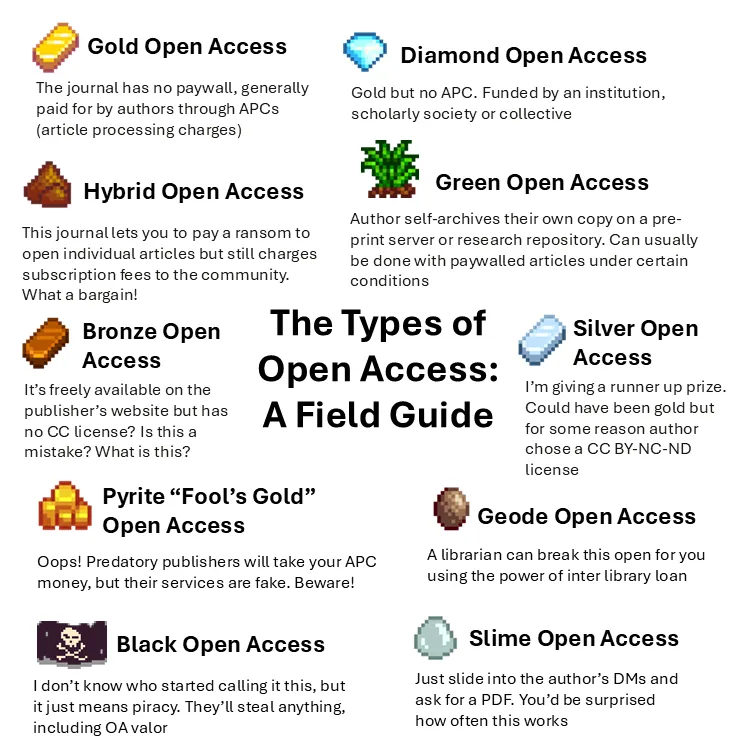
I daresay that adding more and more labels reflects the default compulsion of scholars - acknowledging more and more nuance - rather than providing clarity. The terminology that was meant to help researchers navigate their options ended up becoming the vocabulary through which we offer industry critique.
If we continue to use this language to explain the many "pathways to open access" it doesn't feel inviting - it feels like a warning to authors that there's a long and treacherous road ahead, quite unlike the 1990s promise of the "Information super highway" in its simplicity and freedom. Instead we've got traffic lights, obstacles, conflicting lanes, high tolls, and it's unclear where we’re even meant to be going.
Language shapes perception. And perception shapes behaviour. Open access is difficult to navigate, at least in part, because it is described that way.
Discuss on Bluesky
I only just learnt "green" open access was named after a traffic light. Wrote about this and other word association crimes #academicsky 📚
— Hannah Shelley, MLIS (Metadata, Lattes & Impostor Syndrome) (@hannahshelley.site) April 27, 2026 at 11:58 AM
[image or embed]