The question of who gets to call themselves a librarian is far more contentious than it has any right to be.
Matthew Murray's fun librarian alignment chart has lived rent-free in my head since I saw it a few years ago.
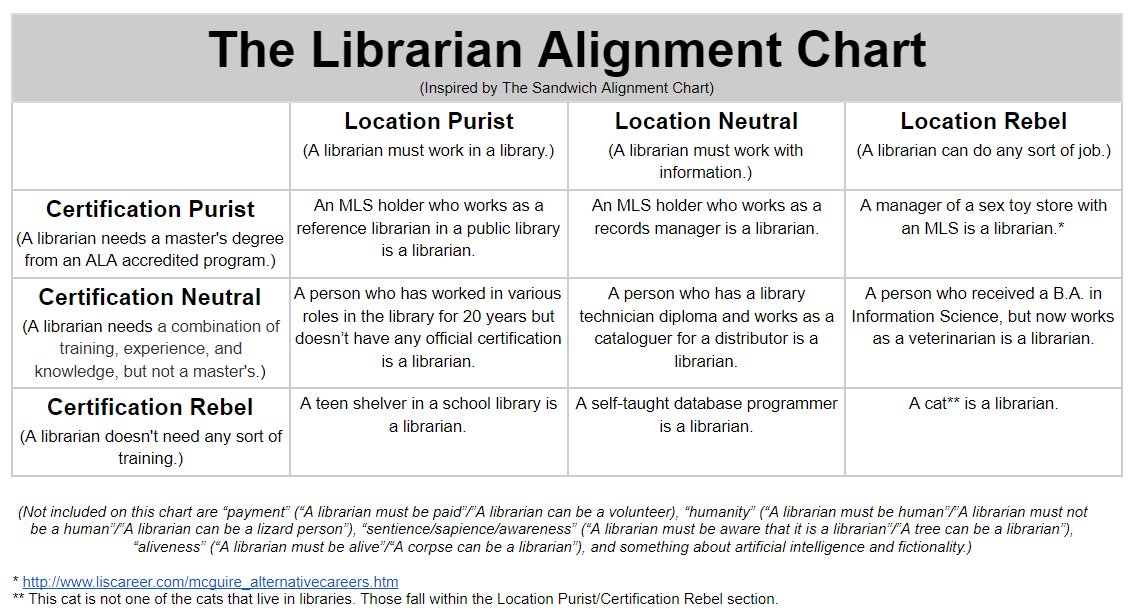
There's a lot of baggage around defining a librarian: questions about qualifications, anxieties that the public doesn't understand what we actually do, and competing identity narratives. So let's dive into 3 frameworks for defining a librarian.
1. The organisational title
I'm a librarian who hires and supervises librarians and library workers. So allow me to put on my HR/management hat here. Job titles are organisational tools. They signal scope of responsibility, required qualifications, and remuneration.
In Australia, there are three broad categories of library workers. Library assistants, library technicians, and librarians.
Library assistants do things like customer service, book shelving, and processing and admin work. These roles usually need no formal qualifications.
Library technicians need a diploma accredited by the Australian Library and Information Association (ALIA), usually through TAFE (Technical And Further Education). They are involved in specialised tasks like cataloguing, inter-library loans, maintaining operational systems, and generally holding more responsibility within a library team.
Librarians need a university degree recognised by ALIA. Unlike the US, it does not need to be an MLS/MLIS - there are undergraduate and graduate diploma courses that are ALIA-accredited. A lot of librarians do have a Masters though, often because they already have an undergraduate degree in something else and it's quicker to top it off with a Masters.
There are rare exceptions to the rule. You might find a systems librarian with a degree in systems administration rather than information studies, for example. There are also cases where an experienced library technician would be suitable for a librarian role. These are questions for hiring panels to weigh case by case.
Librarian jobs vary enormously - across specialisations, across different libraries and information services, and within any given role from day to day. At its core, it involves managing information and enabling people to find, access and use it. Some of that is back-end systems work, some is direct service and instruction, some is management and planning. Just don't confuse them with archivists, or they'll both get mad.
2. The social label
I suspect that to 90% of people, a librarian is a person who works in a library. Some people don't like this. While technically not true from the organisational perspective, it makes sense in context and is simple and elegant in its own way. We can have some flexibility here without launching into a "well ACKtually" defense about how librarians need Master degrees and are talented and underrated. People who use this definition are not wrong and they're not trying to undermine anyone's expertise. They're just talking about something different. Though they may express innocent surprise that librarianship is something you can even study at a Masters level.
The gap between perceptions of librarians and professional reality are a frequent area of study in the library studies literature. It's been observed in several reviews that "librarianship is perceived as a low-status semi-profession, focusing on managing books and performing repetitive tasks." This self-diagnosed image problem holds that the public doesn't understand what librarians actually do, and this misperception undersells a sophisticated professional field.
The thing is, this description actually does describe a lot of jobs in libraries. Library assistants and technicians often undertake the majority of front counter customer service and are probably the most visible to clients. As I've written before, librarians cringe at this for some reason, but books are still our core business! If someone's definition of a librarian is "someone who works at the library and helps me borrow books" - I don't really see the problem. The reality is we're a workforce with differentiated roles, all of which are important. It's possibly kind of classist and gatekeeping to fret about being mistaken for your lesser-paid colleagues? Just something to think about?
That said, it wouldn't be fair to say the profession's image anxiety is just about vanity or professional ego. It has practical stakes. If funders, administrators, and politicians don't understand what qualified librarians do, if they don't realise the value of the work - the information literacy education, the collection development expertise, the research support, the systems work - they may make resourcing decisions that hollow out those functions. But this is an area where we need strong advocacy happening at a high level, not to be worried about casual use of language.
3. The identity
There is also a third meaning, which I've kind of woven through my discussions of the previous 2 frames but it's worth addressing directly: "librarian" as more than a job title but as a professional or even personal identity. It's a set of values, a sense of mission around information access and intellectual freedom. Which perhaps explains why the discussion on defining the profession gets so intense.
Often, this professional pride can take on an almost mythological quality. Fobazi Ettarh [1] referred to this as "vocational awe" - "the set of ideas, values, and assumptions librarians have about themselves and the profession that result in notions that libraries as institutions are inherently good, sacred notions, and therefore beyond critique".
Having a sense of meaning and purpose in your work is a good thing. It will give you job satisfaction and a rewarding intellectual community with your colleagues. You could also make the argument that you need to care about these things or you probably won't be effective at the advocacy work that's so often required. But what happens when a librarian takes a job that doesn't serve those values? For example, does working for a private library with restrictive information policies make you less of a "real librarian"? Tying professional skills too closely to a specific mission can get messy.
Furthermore, librarianship wasn't always tied to ideals of intellectual freedom and open access - librarians were literal gatekeepers, restricting who could access what. Historically, libraries were exclusive repositories for scribes, priests, and the elite. The professional identity we've built around empowering people with access to information is a relatively modern construction, emerging alongside movements for universal education and democratic reform, further enabled by technological change in the 20th and 21st centuries - not something timelessly inherent to librarianship.
In conclusion
A librarian is whoever or whatever the context calls for. Organisations need titles to function, the public uses words to mean things, and people are entitled to carry their professional identities around like a little trinket that gives them inspiration and purpose. Trouble arises when we conflate these meanings. None of this is actually that complicated - except that it is, apparently, because we keep writing about it. Myself included.
[1] I was very saddened to hear of Fobazi Ettarh's passing on 28 January 2026. She was my age. Her work continues to have a profound influence on librarians around the world to be more reflective and critical about our practice, myself included. I've referenced her "vocational awe" essay on this blog twice now, and it's unlikely to be the last time. May she rest in peace.
Discuss on Bluesky
What is a librarian? A job? A social label? A vocational calling? A person who can't stop answering the question "what is a librarian"? (wrong answers only)
— Hannah Shelley, MLIS (Metadata, Lattes & Impostor Syndrome) (@hannahshelley.site) February 18, 2026 at 10:09 PM
[image or embed]