Hannah's Web log
Simulacra and Citation
15 May, 2026 | 5 minute read
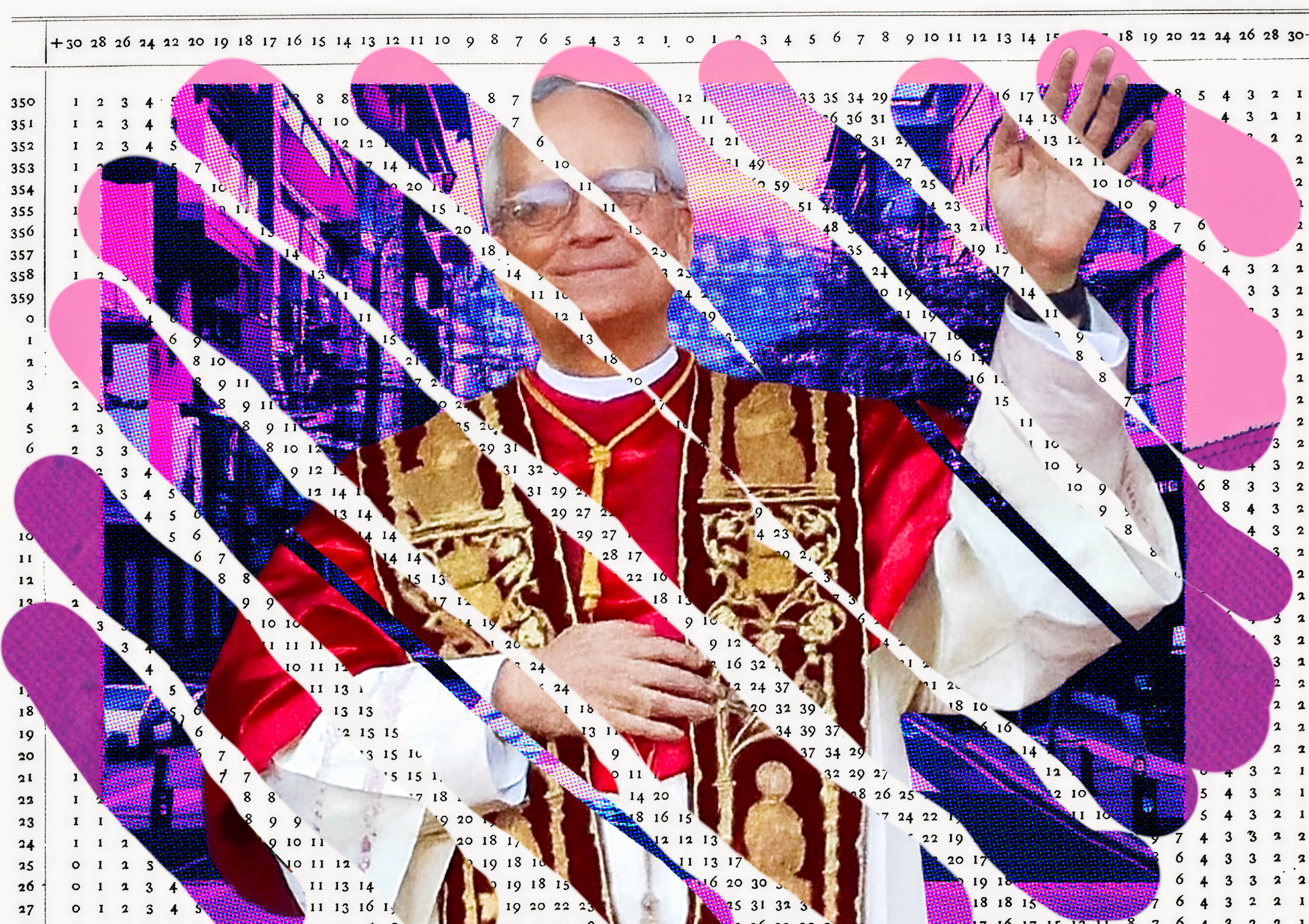
(Image: Hannah Shelley. Licensed under CC BY-SA 4.0. This work incorporates: Pope Leo XIV on the loggia after his election, Edgar Beltrán / The Pillar, CC BY-SA 4.0 | Is This Even Real II, Elise Racine, CC BY 4.0 | Seeing More — Seeing Less, Anna Riepe, CC BY 4.0 )
A few weeks ago I enjoyed this Bluesky post by Eryk Salvaggio.
Is Pope Leo reading Baudrillard
— Eryk Salvaggio (@eryk.bsky.social) April 22, 2026 at 10:11 AM
[image or embed]
The short and boring answer is: Yes, the Pope has almost certainly read Baudrillard. Any theologian seriously engaged with questions of media and culture would very likely have encountered Baudrillard, indirectly at the absolute least. But the language of this tweet, using Baudrillardian keywords like "simulation", and basically offering an enyclopedia definition of Baudrillard's concept of hyperreality, he actually seems to have absorbed his ideas quite closely. Of course there are fundamental differences between Baudrillard's secular, postmodern scepticism toward absolute truth, and the Pope's deeply traditional Christian worldview where truth is understood as objective, transcendent, and ultimately grounded in God. The tension is funny, but Baudrillard's ideas still remain extremely useful for critiquing communication in the contemporary world, even to the Pope, it would seem.
I'm actually less interested in tracing the intellectual connections between Postmodernism and Catholicism, though I have no doubt there is plenty there to explore if I wanted to.
My interest is to answer the question more literally, more bibliographically. I wanted to exercise my librarian skills and create something of a citation chain between the two men. Like 6 degrees of Kevin Bacon but with footnotes.
As a typical librarian about to embark on a reference quest in some specialised area, I have a lot of general knowledge but I'm not a true subject matter expert. I studied Baudrillard in high school, even did an assignment on him. I read at least most of Simulacra and Simulation, and still have a copy somewhere. The general ideas stuck with me enough that I am reminded of them often. I don't know much philosophy, and Baudrillard is probably the philosopher I know best. So whenever his name comes up, I think: there's my homeboy.
I am also quite interested in theology, but tragically, I am Protestant. Still, I'm quite ecumenically minded, and I work for a Catholic university, so I do have a genuine interest in what the Pope says.
Pope Leo XIV, born Robert Prevost, chose his papal name in part because of his desire to address what he has called the next "industrial revolution" - developments in AI that "pose new challenges for the defense of human dignity, justice and labor." This suggests to me an interest in the theological dimensions of technology and culture. The Pope has been very vocal about social media, AI, and their impacts on human spirituality (see above tweet). So I wondered if he's written on any of this stuff before.
One of my first questions was does Pope Leo have an ORCID? Disappointingly, he doesn't (yes, I checked). But as an author who has published under 2 names, he should get one! Especially when you also consider there are no less than 13 other scholars in history sharing the name Pope Leo. Name disambiguation is important! I even found a researchgate profile for another Robert Prevost, who, to my delight, is a scholar of both philosophy and religion. It's not him though.
Pope Leo's publication history is small. His thesis is about canon law in the Augustinian order, and his handful of book chapters and journal articles are all along the same lines. This is not my wheelhouse and I don't think Baudrillard's either.
A better place to get some in-roads might be recent Vatican statements, as that's where his recent outputs are. The Vatican archive is pretty good to search - full text indexed, hyperlinked references, unfortunately it isn't indexed in tools that can help with citation mapping like Semantic Scholar or Lens, which deal mostly with DOI-assigned papers. Theology documents are a bit more esoteric. I did a search of their archive for "Baudrillard" - 0 results of course. That was always going to be a bit of a hail Mary (sorry).
But then the next best thing happened. I also did a search for "simulation" and THE ORIGINAL CONTEXT OF THE TWEET appeared. The paragraph in the tweet was part of an address to university students and professors at the Catholic University of Central Africa. I hadn't expected that. I thought the Pope's tweets were just tweets, not excerpts from his official addresses. So did he cite Baudrillard? (Or even another philosopher close to Baudrillard?) Technically, no. He cited other Popes, he cited the Bible, he cited 19th century theologian John Henry Newman in The Idea of a University.
But I was fascinated by the idea that this document, an address to Catholic university students and academics was, institutionally speaking, indirectly aimed at me. The Catholic intellectual tradition of the pursuit of truth and knowledge, the thing that genuinely inspires my work, and the thing I was engaged in doing right now just for fun. Trying to uncover the empirical truth of the matter.
I realised nothing short of a direct written reference could ever "prove" Pope Leo had read Baudrillard. And that smoking gun probably didn't exist. The undocumented hint of semantic resemblance, the self-referential loops I got stuck in looking for the answer were the closest thing to an answer I was going to get.
As Simulacra and Simulation argues, we inhabit systems of signs that refer mainly to one another rather than an underlying reality. And as the Pope elaborates, this weakens our capacity for discernment. That's where I was. In a simulation. Looking at systems of references that point to other references - tweet screenshots, hyperlinks, PIDs, search results - unable to discern a deeper reality. So I can't help but insert myself into this citation chain, if you can call it that. A teenager half-reading Simulacra and Simulation for a high school assignment eventually becomes a librarian searching Vatican archives for traces of postmodern philosophy in papal statements, after seeing a joke on Bluesky, referencing a tweet referencing something else. Baudrillard would probably say the distinction between "real" intellectual influence and the "appearance of" intellectual influence has, by this point, collapsed entirely.
And now that I've written a blog post citing both Baudrillard and Pope Leo, I've closed my own loop.
Probably my weirdest and most niche blog post yet. I got nerd-sniped. You know how it is
— Hannah Shelley, MLIS (Metadata, Lattes & Impostor Syndrome) (@hannahshelley.site) May 15, 2026 at 6:38 PM
[image or embed]
